This article is part of a wider body of work exploring embodiment, sovereignty, and feminine authority as lived states rather than abstract ideals. Many of the themes here weave into my Mystery School architecture, which explores how power stabilises in the body before it expresses in life. If you want the wider map, begin with Female Archetypes of Power: From Martyr to Empress. Updated February 2026
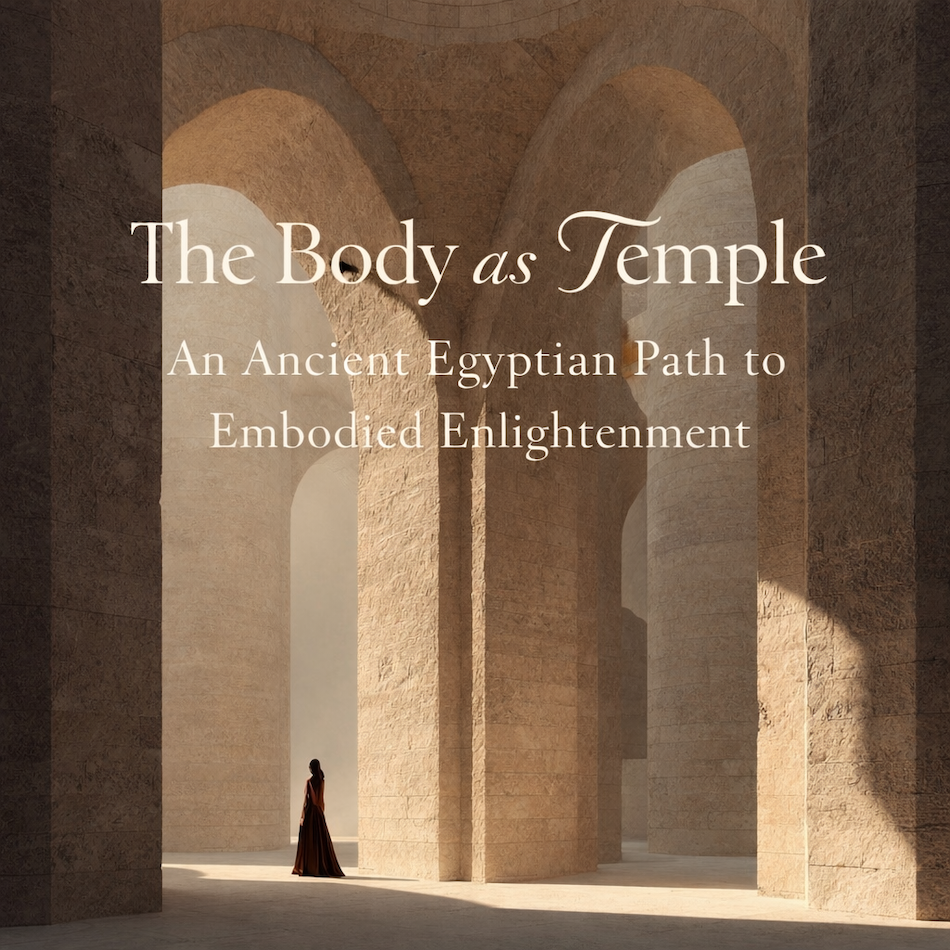
The Body as Temple: What Egyptian Spiritual Philosophy Taught Me About Embodied Enlightenment
I read Egyptian Yoga: The Philosophy of Enlightenment years ago, long before I had language for my current cosmology. At the time, I did not fully understand why it affected me so deeply. It was not a book about exercise, flexibility, or physical mastery. It was not even really about yoga in the modern sense.
It was about something far more arresting.
The body as temple.
Not as metaphor. Not as poetry. As a lived spiritual architecture.
The book presented an ancient Egyptian philosophy in which enlightenment was not achieved by leaving the body behind, but by inhabiting it with such coherence that consciousness could stabilise inside form. Posture mattered. Stillness mattered. The way one held oneself in the world was inseparable from spiritual maturity.
Something in me recognised this immediately, even before I could explain why. Looking back now, I can see that this text quietly shaped how I understand embodiment, dignity, and power. It laid groundwork for the work I do today, long before I knew what to call it.
The Body as Temple in Egyptian Spiritual Philosophy
In ancient Egyptian spirituality, the body was not something to overcome or escape. It was something to prepare. Something to refine. Something to make worthy of housing consciousness.
This is where the phrase “body as temple” takes on its true meaning. The body was treated as a sacred structure, one that required order, alignment, and reverence. How one stood, sat, walked, and breathed reflected inner harmony or inner fragmentation.
Stillness was not passive. It was disciplined. It required inner regulation, composure, and presence. A body that fidgeted, collapsed, or braced was understood to be a body that could not yet hold higher awareness without distortion.
This philosophy is often misunderstood when filtered through modern wellness culture. Egyptian spiritual practice was not about release or expression. It was about containment. About creating a vessel stable enough to carry truth.
If you are curious about the original source that shaped this understanding for me, you can find the book Egyptian Yoga: The Philosophy of Enlightenment here.
Why This Was Never About Yoga Poses
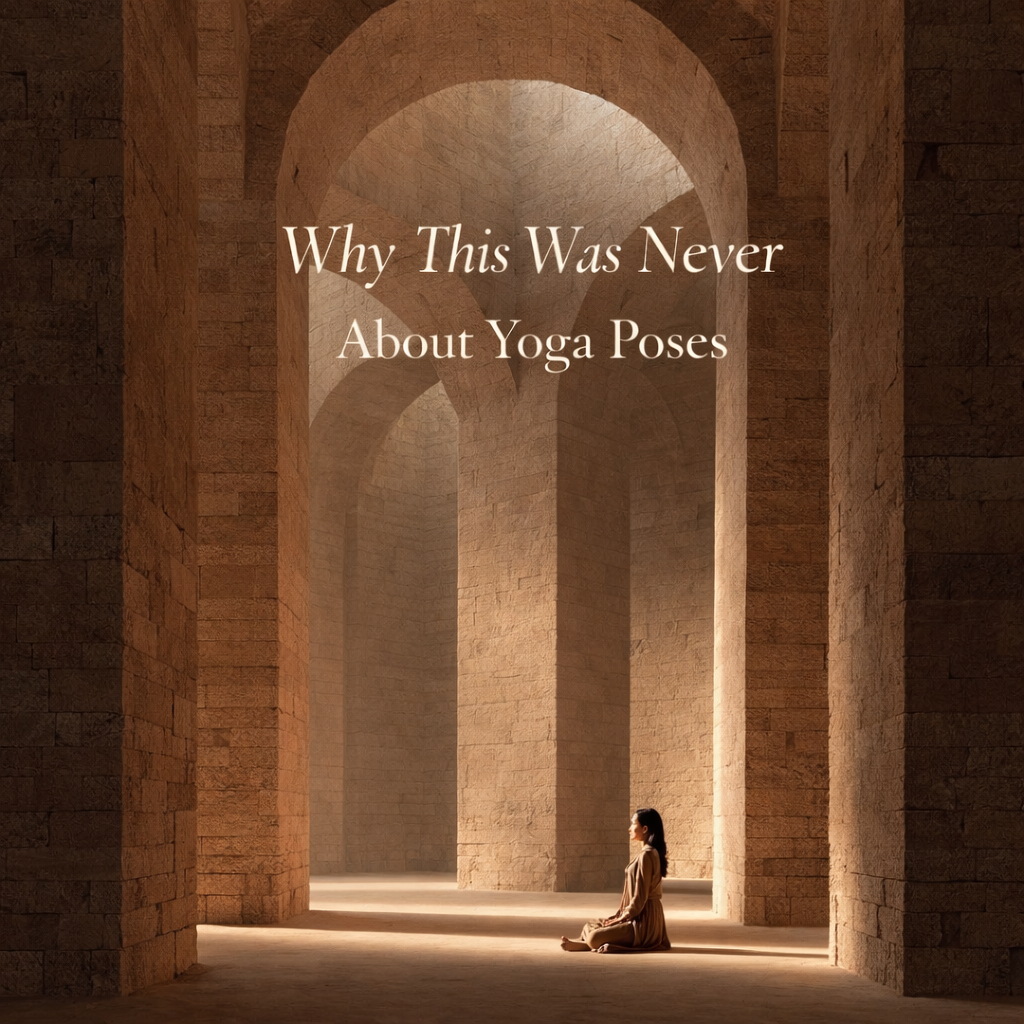
Despite the word “yoga” in the title, this philosophy is not describing a physical practice in the contemporary sense. The word is used to gesture toward union, integration, and alignment of consciousness.
This distinction matters. It keeps us grounded. Egyptian spirituality was not interested in flexibility, performance, or catharsis. It was interested in sovereignty. In self mastery. In the ability to remain internally ordered regardless of external conditions.
The body as temple is not about how the body looks. It is about how the body holds presence. A temple does not contort itself. It stands. It contains. It signals stability.
What Stayed With Me Long After I Closed the Book

What stayed with me was not historical detail. It was the felt truth that enlightenment is not a peak experience. It is a capacity.
A capacity to remain present without bracing. A capacity to hold power without leaking it. A capacity to live inside the body without constantly overriding it.
This insight has only deepened as my work has evolved. I see it reflected again and again in women who come to me. They are not lacking awareness. They are often deeply intuitive and perceptive. What is missing is containment.
Without containment, softness feels unsafe. Without structure, receptivity feels like exposure. The body becomes something to manage rather than inhabit.
This is why the concept of the body as temple is so central to my work now. Self worth is not just a belief. It is a posture. A way of holding oneself, one’s time, one’s energy, and one’s life.
You can see this explored further in The Field of Self Worth: How the Universe Reflects the Value You Hold.
The Body as Temple and Nervous System Safety
When the body is treated as a temple, it cannot be constantly violated. Overextension, urgency, emotional labour, and perpetual availability are not neutral behaviours. They erode the structure.
A temple requires rhythm. Boundaries. Clear thresholds. This is not rigidity. It is what allows softness to remain open without being consumed.
This is why nervous system safety is not a side topic in my work. It is foundational. A nervous system that does not feel safe will recruit the body into survival, no matter how spiritually aware the mind may be.
If this resonates, you may want to explore The Nervous System Is Not a Side Topic. It Is the Gatekeeper of Your Reality.
From Ancient Temple to Modern Feminine Power
I do not reference Egyptian philosophy to romanticise the past. I reference it because it gives language to something many women feel but cannot name.
The longing for composure. The exhaustion of bracing. The sense that softness cannot stabilise until life itself is redesigned to hold it.
This is why my archetypal work is not about identity, but about architecture. Each stage of feminine power requires a different relationship to the body and to structure. You may recognise this progression in The Martyr Archetype and The Mother Archetype.
The Queen draws the line. But it is structure that allows her to rest.
Living the Body as Temple Today
Living the body as temple does not require ancient rituals or rigid discipline. It requires honesty.
Honesty about what your body can hold. Honesty about where your life violates your nervous system. Honesty about the difference between being open and being overrun.
When the body becomes a temple, dignity becomes non negotiable. Pace changes. Access becomes deliberate. Life reorganises around coherence rather than urgency.
Work With Me
If this way of understanding embodiment resonates and you want support integrating the body as temple into your lived reality, there are ways to work with me more closely.
→ Explore the Journey Back to the Feminine



One Reflection
Share your reflection below... I’d love to hear how this transmission lands for you.
This reflection space is part of a living temple of dialogue, a place for insight, resonance, and respectful exchange. All comments are read with care and may be lovingly edited for clarity, formatting, or safety before publication. Please share from your heart, speak with kindness, and keep this space high in frequency. Promotional links, aggressive language, or off-topic content will be removed. Thank you for honoring the spirit of this sanctuary.